
Po = πr2
P□ = a2 = (2r)2 = 4r2
Po πr2
—— = ——
P□ 4r2
Po π
—— = —
P□ 4
Po k
—— ≈ —
P□ n
π k
— ≈ —
4 n
4k
π ≈ ——
n
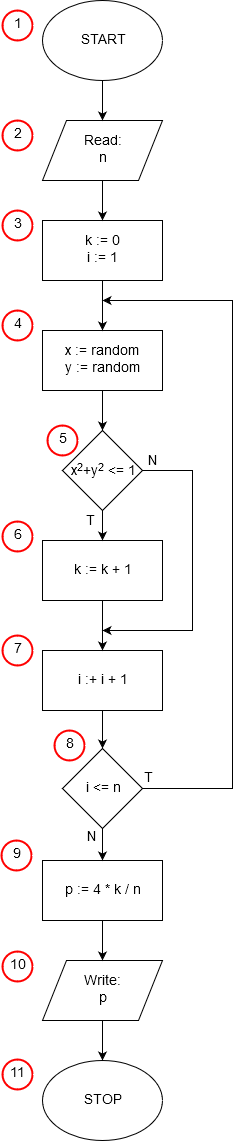 Implementation of the algorithm in language: Pascal, C++, Java, Python, JavaScript
- START - The beginning of the algorithm.
- We read the number of points to be generated (sampled).
- We reset k - the counter for points contained within the circle of radius 1 (set k=0). We assign the initial value of 1 to the variable i, which counts the number of points sampled (set i=1).
- We generate two random numbers in the range from 0 to 1 - the x and y coordinates of the point.
- We check if the sampled point with coordinates x,y lies within the circle of radius 1. (Is x2+y2≤1?)
- If the condition from point 4 is satisfied, we increase the value of the variable k (the counter for points contained in the circle of radius 1) by 1. If the condition is not met, we skip this step.
- We increase the sampled point counter i by 1.
- We check whether more points should be sampled (Is i≤number of points?). If yes, we return to step 3 of the algorithm.
- We calculate and store the approximate value of π in the variable p (using the formula p=4⋅k/ik).
- We display the result.
- STOP - The end of the algorithm.